
At Exeter Eye, every cataract patient is invited to complete the Cat-PROM5 before and after surgery, ensuring care is guided by real-world outcomes.
Patient-Reported Outcome Measures (PROMs) are short questionnaires that ask patients how their health and quality of life are affected by treatment. In cataract surgery, they capture the patient’s perspective on how well they can see and function in daily life, things like reading and driving.
Doctors collect PROMs because they add something unique to traditional medical tests.
They:
For patients, PROMs show that their surgeon values real-life outcomes and is committed to learning from feedback.
Traditionally, cataract surgery success was judged by vision tests like post-operative visual acuity (reading the letters on the vision chart). While important, they don’t tell the whole story. A person might see the small letters on the chart but still struggle when driving at night, or with fine print under low light.
PROMs address this gap. They ask about functional vision, the everyday experiences that determine quality of life. As the Private Healthcare Information Network (PHIN) explains, clinical exams measure vision in the clinic, but PROMs capture “what matters most to you: your ability to do the things you want to do.”
By combining medical results with PROMs, surgeons get a complete picture: not only whether the surgery technically worked, but whether it made a meaningful difference in the patient’s life.
One of the best tools for cataract PROMs is Cat-PROM5, developed in the UK. It consists of just five carefully chosen questions that reflect the most common difficulties cataracts cause, such as problems with glare or reading.
To design it, researchers tested a large pool of questions with hundreds of patients across several centres. By analysing many questions, they identified the five items that best captured cataract-related visual problems. The result is a questionnaire that is:
In short, Cat-PROM5 is quick to complete but powerful enough to provide meaningful feedback on surgical outcomes.
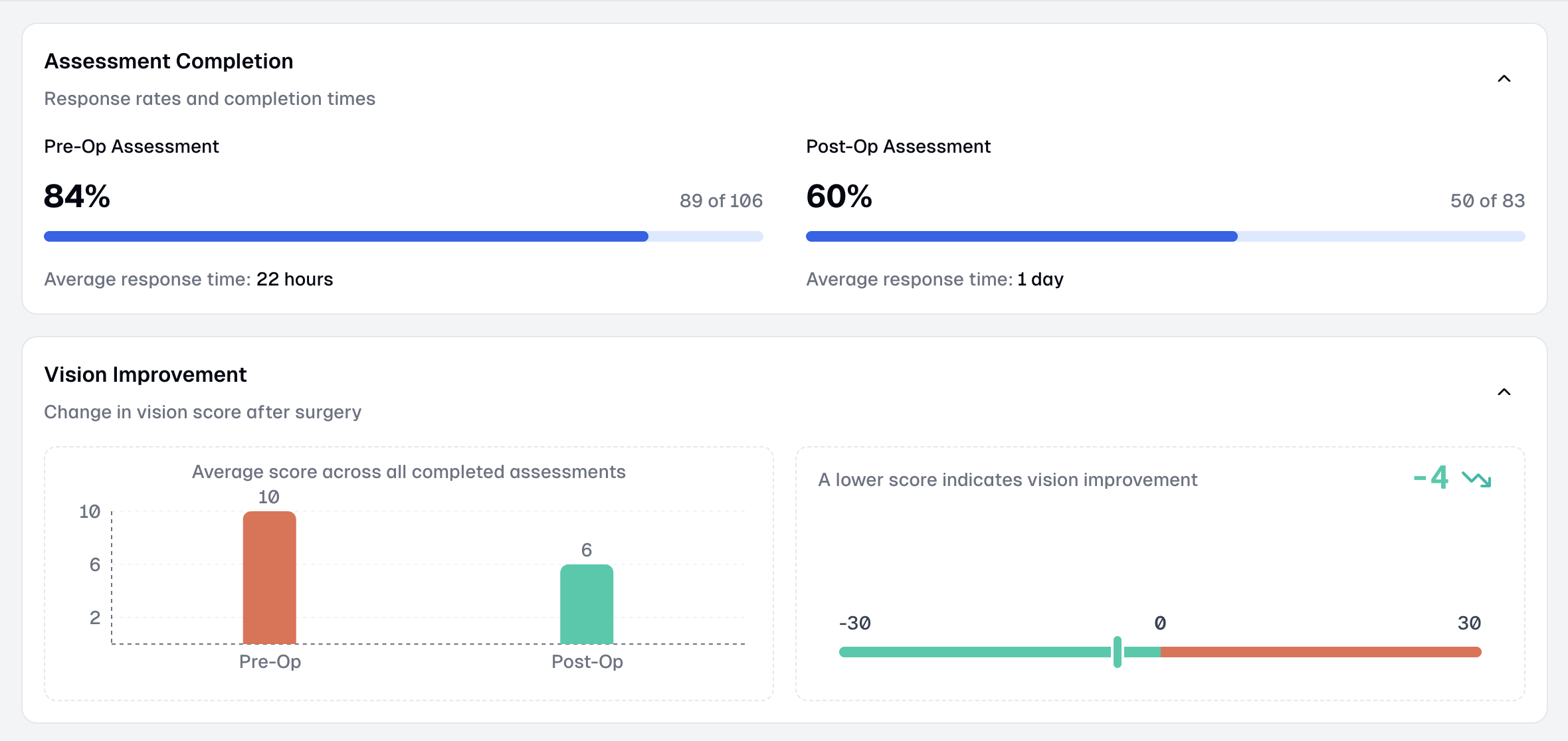
Collecting PROMs is not just good practice; in UK private healthcare it is also a requirement.
Cataract surgery is one of the procedures where private hospitals must gather PROMs. Patients complete the questionnaire before surgery and again a few weeks later.
The Private Healthcare Information Network (PHIN) notes, if a hospital is not collecting PROMs, patients should ask why, because collecting them is a clear sign the provider is serious about outcomes.
At Exeter Eye, we fully support this initiative. All cataract patients are invited to complete the Cat-PROM5, before their operation and again afterwards. These results sit alongside your clinical examinations, giving us a much fuller picture of your recovery.
If your eyesight on the chart improves but your PROM suggests you’re still struggling, we know to look more closely and offer further support. PROMs also allow us to demonstrate, transparently and objectively, how our patients benefit from surgery.
By collecting PROMs, Exeter Eye shows our commitment not only to technical excellence in surgery but also to listening to our patients. For us, cataract surgery isn’t just about clearer vision on a test; it’s about restoring confidence, independence, and quality of life.
To collect the Cat-PROM5, we’ve teamed up with Lutra Health and we are seeing a great response rate.

Copyright © 2026 All Rights Reserved | Privacy & Cookies | Accessibility | Translate | website by: www.onebrightspark.co.uk